Never ever had anyone suggested I was college material until I had to visit my high school guidance counselor after Christmas vacation my senior year to inform him that I had to graduate early because I was pregnant. Even though I got really good grades, I had never met with the counselor before. So when he said, “Too bad, you could have gone to college,” I wanted to scream. “Now you tell me!!!”
My family never uttered a word about college either. As a kid, my family would drive by the fairy tale like campus of Mount Mary on the way to grandma’s house. On one occasion, I asked my dad if I could go there someday. His reply was, “If you get a million dollars.” College was only for rich kids and certainly not for girls like me.
Fast forward—I’m 22 years old, a single mom with a three year old and a baby on the way. My divorce pending. When my welfare case worker quietly said, “Elaine, you seem pretty smart. Have you thought about going to college?” My jaw dropped to my knees.
She gave me a card for the Equal Education Opportunity Center. I called the next day and made an appointment. With my rambunctious three year old Sam in tow and my protruding belly thrust out before me, I met with a friendly woman who didn’t bat an eye. Yes, she said college was possible for me. She would help me start the paper work for what was called a Pell Grant. A fabulous federal financial aid program that provides money to undergraduate students with exceptional financial need. I certainly fit the bill. But I figured it was maybe just for things like CNA or secretarial training. But I wanted more than that. So I asked, “Could I go to Mount Mary?” And the answer was yes. I literally skipped back to my car.
Still worried about the potential for crippling student loans, I considered my options. I got a sitter and drove to UW Milwaukee for an information session. It was disastrous. I couldn’t find a place to park. I got lost looking for the right building. I checked out the day care but it was so far from so many of the buildings on campus. I got lost again trying to find my car. This wasn’t for me.
I thought about capitalizing on the secretarial skills I had acquired in high school by going to MATC to become a legal secretary. I called and they abruptly told me the program was full and they were not accepting any new applicants.
Finally I made an appointment at Mount Mary. I pulled out of the gravel driveway of my apartment building in my shitty old Corvair full of expectation. Just a few miles away, I coasted into the majestic tree lined driveway to the campus of grand arched buildings. The heels of my discount pumps clicked on the marble floor. I had dressed for the occasion in my fancy black maternity bell bottom pants and a sky blue pleated top in a ridiculous attempt to hide my belly. Surprisingly I easily navigated my way to the correct office where I met with a middle aged nun in a full habit who seemed happy to see me and assured me that they had many “nontraditional students” on campus. When I worried aloud that Mount Mary would be too expensive even with the Pell Grant, she assured me that there were many other private grants I was eligible for and that she would help me. Then she gave me a tour. The day care was just a room in the basement but it was lively and safe. And I knew I could be with my children in a heart beat if needed. And perhaps most of all, I was lured by this sheltered space only for women. No douche bags in sight to distract me from my goal.
The next step was a career assessment and aptitude test which suggested a major in public relations. When the nun explained what public relations meant, I didn’t have a clue, and showed me the course list—communications, journalism, management— I was sold.
Ben was born on June 26, 1978. My divorce was final on August 22nd. Sam turned 4 on September 1st. My first class at Mount Mary was on September 5th.
Here are my favorite memories:
Early Days
On the first day of class, I hung out in the hall waiting for the bell to ring. I thought it would be like high school.
In the first week, I commented to another student that I was surprised to see so many girls wearing slippers to school. She informed me that they lived in the dorm. “What’s a dorm?” I asked. When she explained, I was flabbergasted. “You can live here?”
In the second week, I almost died of embarrassment when my boob leaked leaving big round wet circles on my sweater. My classmates stared in horror. I needed to get better at pumping.
In the first month, I met Janiece. A woman my age who was in some of my classes. Her student job was working in the day care. We got to know each other and soon we were having lunch together out on the lawn with Sam and Ben. Janiece became a life long friend.
Classes
In one of the first classes of a required philosophy course called Man’s Search for Meaning, the professor was trying to get us to think in philosophical terms. He asked, “Why does the baby cry?” I know all about this so I raised my hand. “His diaper needs changing.” No. “He’s hungry.” No. “He needs to be held and comforted.” “Yes, but why?” asked the professor. Janiece raised her hand and said, “It’s the malevolence of the universe?” “Yes, that’s right,” said the professor. I was dumbfounded.
In another class, I don’t recall what it was called but there was a section on child development. Again, “I’ve got this,” I thought. I’m living it. So, I didn’t bother to read the text book or study for the test. For questions like at what month does a baby first crawl, first walk, and say their first words, my answers were all at least a month earlier than the correct answer. Apparently my kids are geniuses!
I got a D in tennis! Evidently I never figured out how to score correctly or got all the rules straight. And one time I actually tripped on my racket going out to the court. Lowest grade I got. It lowered my almost straight A grade point average considerably. Dang. Maybe I could have been valedictorian.
In another class, it might have been called TV Production, I produced a video of me doing a yoga class just like on PBS. A+! But the most memorable event from this class was a field trip to the nearby medical college which allowed us to experience their professional TV equipment. “Look it’s a dick,” one student exclaimed as the rest of us rushed to look over her shoulder at the monitor. The medical college technician snickered. Douche bags are evey where. Our chaperoning nun went into a tither and the class was abruptly ended.
Best of all, in my Interpersonal Communication class, we were required to start a personal journal. I reread it now with tears in my eyes, grateful that I have this account of what was going on in my head and heart complete with the teacher’s encouraging comments in red ink. Journaling became a life long practice.
Sam and Benny
My boys loved going to “Mountain Mary” as they called it with me.
Sam was a curious kid. He wanted to touch and smell everything. He held dandelions up to his nose. And he was super friendly. Saying hello to everyone we passed. So one day when he was four, as we were walking through the little tunnel that connected buildings on our way to day care, we crossed paths with a nun riding in a motorized wheel chair her veil flowing. “Wait! Wait! Wait” shouted Sam. The nun stopped to indulge him for a few minutes. Sam felt the tires and walked around the wheel chair to inspect it. “How does this work?”he asked the sister. And she indulged his curiosity by showing him how the lever made it go forward and back. And then to my horror, she let him move it forward and back. I had images of the poor elderly nun crashing into a concrete wall. Sam jerked the lever forward and back a little but nothing tragic happened. I will never forget the kindness of that nun.
At home one morning at our apartment, I practiced a presentation for a class, while toddler Benny sat in his high char slurping cereal. Benny fell dead asleep his face in his bowl. Back to the drawing board.
We had a class field trip to the Milwaukee art museum. Only problem was that children weren’t allowed to stay in the day care if you weren’t on campus. But the kind nuns told me that I could just take little 18 month old Benny with me. Sam was in kindergarten by that time. So, great idea. Just take my toddler along. The other students helped me get Benny’s stroller on the bus and I held onto him tightly through the bumpy ride. He enjoyed it immensely, Laughing and babbling. But when we got inside the museum, it was another story. Perhaps overwhelmed by the malevolence of the universe inside of the cavernous galleries, he waled and screamed his head off. He kept kicking off his shoes until I didn’t bother to replace them. He was such a distraction that I had to take him into another room missing the majority of the tour. On the return trip, Benny just sobbed in my arms. As we departed the bus my classmates awkwardly clunking the stroller down the bus steps, a nun pulled me aside and said, “I’m so sorry.” But all is forgiven. I’ve had dozens more trips to the very same museum in my life. None of them with Benny.
And then there was the time that I went to pick Benny up from the daycare room and everyone was laughing when I got there. Three kids including Benny were on the floor swirling some liquid around and having the time of their lives. The two caregivers were hunched over in tears. “What happened?” I asked. Through snorts of laughter they explained that one of the kids knocked over their juice. And when they went over to clean it up, another kid tipped over their juice. She said, “And then Benny poured his juice on the floor and got down on the floor to join the fun!”
By the way, I packed his snacks and labeled them so his little bottle said “Benny Juice,” which a newbie day care staff once wondered what Benny Juice was. Don’t you know? It gives you super powers!
Graduation Day
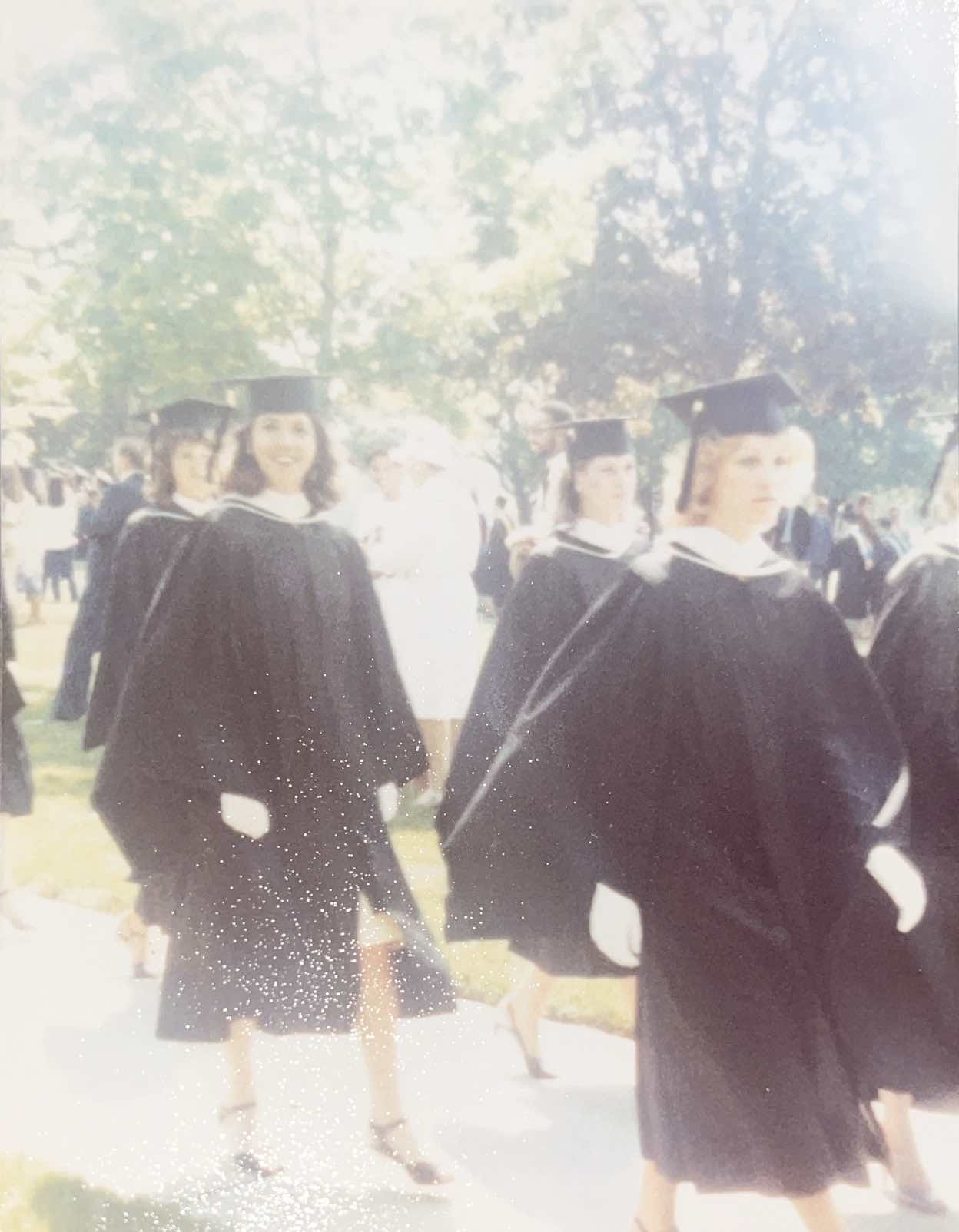
I graduated suma cum laude in 1982, just four years time with minimal student debt. Dad didn’t attend. He went fishing. But my grandmothers, mother, and boys attended. I was so proud of myself! Later, my parents had a big surprise celebration for me in their yard. Some of the nuns came!
In Summary
Attending Mount Mary was the pivotal decision of my life. I am thankful not just for the career my Mount Mary education launched for me, but for the sense of self and the confidence found in the embrace of a circle of women.
I regret that I don’t remember the names of my specific teachers except for Suzanne Walfoort who taught a communications class. She was an amazing role model and someone I felt comfortable sharing my doubts and fears with. (Years later I met her sister who happened to be married to a friend of my husband.) I would like to thank all of my professors as well as all of the nuns in financial aid and administration for their kindness and unwavering support
I am also overjoyed by Mount Mary’s accomplishments. When I was Executive Director of the Women’s Fund, with our support they started the Women’s Leadership Institute which continues to flourish. More recently, I was able to tour their incredible new facilities—a retirement community for nuns and older adults next to a dorm where women can live with their children complete with a shiny new day care! Yes, you can live at school!
When I gaze upon the surviving blurry photos from that time I feel that sense of immense joy all over again. It wasn’t easy. I worked really hard. But I really did achieve the impossible dream on that fairy tale campus . I had the “courage to reach the unreachable star.”





 Stories from my breezeway